

The story of the Jewish people is breathtaking, marked by soaring triumphs and devastating tragedies, eras of peace and times of turmoil, towering heroes and bitter enemies, persecution and renewal. Yet it can be argued that the 70-year span in which lived the Sixth Rebbe, Rabbi Yosef Yitzchak Schneersohn, of righteous memory,was among the most dramatic of all.
It was into a world in upheaval that Rabbi Yosef Yitzchak was born in 1880, his childhood and adolescence framed by the violent pogroms and revolutionary turmoil sweeping across Russia, all accompanied by fierce internal conflicts within the Jewish world. By the time, in 1920, that he succeeded his father, Rabbi Sholom DovBer Schneersohn, as Lubavitcher Rebbe, World War I and the Bolshevik Revolution had transformed everything, and the nascent Communist regime was embarking on a harsh and fanatical campaign of religious persecution. In the decades that followed, he lived through World War II, the horrors of the Holocaust, and the rebirth and flourishing of Jewish life on American soil.
The Sixth Rebbe was not a bystander to the events of his era. A fearless, visionary leader who stood firm against every force that sought to undermine Judaism, he never wavered: Not in the face of Czarist dictates, Soviet oppression, Nazi brutality or the widespread apathy he encountered upon his 1940 arrival in America. Through every chapter of upheaval, he remained steadfast, undaunted.

This extraordinary life story is now told for the first time in a landmark new biography by Rabbi David Eliezrie. Released on Nov. 4 by Toby Press, Undaunted illuminates, as its subtitle states, “how the Sixth Rebbe saved Russian Jewry, reimagined American Jewry and ignited a global Jewish renaissance”.
“I have always felt that the Sixth Rebbe never received the historical recognition he deserved,” says Eliezrie, a long-time Chabad-Lubavitch emissary who serves as director and senior rabbi at Chabad of Yorba Linda, Calif. “Here was a man who built a vast Jewish underground network under the noses of the Soviets and then went on to spark a Jewish renaissance from America, at a time when many saw it as a place where Judaism went to die. The sheer upheaval of the era meant that his story was never fully documented for posterity.”
Born Into Leadership
Rabbi Yosef Yitzchok Schneersohn was born in the summer of 1880 in the White Russian village of Lubavitch. A scion of the Chabad-Lubavitch Rebbes, he was raised in a home steeped in leadership; his father, Rabbi Sholom DovBer (1860-1920), served as the Fifth Rebbe of Chabad.
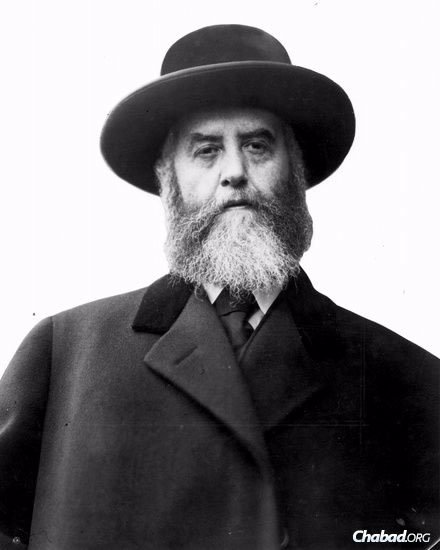
Already as a child, Rabbi Yosef Yitzchok understood what it meant to stand up for another Jew. He was 12 years old the first time he was arrested and imprisoned, accused by a Russian policeman of meddling after defending a Jewish merchant from the former’s wrath.
When he turned 15 his father formally appointed him to a role of communal leadership, a position that encompassed both spiritual and material responsibilities. While the primary focus of the Rebbes of Chabad was to teach Chassidut and guide their Chassidim in their spiritual growth, they had always stood at the forefront of activism on behalf of the Jewish people in whatever role was needed at any given time. It would be an era in which such work on behalf of the Jewish people was indispensable.
During the seven-day sheva brachot celebration following Rabbi Yosef Yitzchok’s wedding, his father announced that he would start a new Chassidic yeshivah, which he would soon name “Tomchei Tmimim.” A yeshivah that included the systematic study of Chassidut was unheard of, and the new institution would be a first in history. Rabbi Sholom DovBer appointed his newly married son as the executive director, entrusting him with overseeing both the students’ spiritual development and their material needs.
The outbreak of World War I saw Rabbi Sholom DovBer relocate his court east, to the Russian city of Rostov-on-Don, bringing an end to the 102 year period during which the Chabad-Lubavitch movement called the village of Lubavitch home. The subsequent Russian Revolution plunged the already-shaken country into even deeper chaos, and the rise of the Soviet regime boded ominously for Russia’s millions of Jews and especially for a Chassidic movement devoted to spreading Jewish education and observance.
Rabbi Sholom DovBer passed away just as the new Communist government consolidated power and prepared its frontal attack on religion, leaving the leadership of the Chabad movement in the hands of his son, Rabbi Yosef Yitzchok, who immediately assumed position as the Sixth Rebbe of Chabad. The new, 39-year-old Rebbe set out to strengthen the fragile spiritual life of Jews across the USSR, which was coming under particularly ferocious and relentless attack. At a time when rabbis were being exiled to Siberia, synagogues were confiscated and converted into “Workers’ Clubs,” and even ordinary Shabbat observance was labeled a “counter-revolutionary” act, Rabbi Yosef Yitzchak sent emissaries to establish underground Jewish schools, build mikvaot (ritual baths), and teach Judaism to both youth and adults, despite the grave risks to freedom and even life.
These efforts came at a steep personal cost. The Yevsektzia, the Jewish sections of the Communist Party, surveilled, harassed and persecuted the Sixth Rebbe and his Chassidim with single-minded determination. They did not rest until they succeeded in having the Rebbe arrested, in the summer of 1927, on fabricated “counter-revolutionary” charges and sentenced to death. Only an international outcry resulted in his sentence being commuted, first to hard labor, then to internal exile and then annulled entirely.
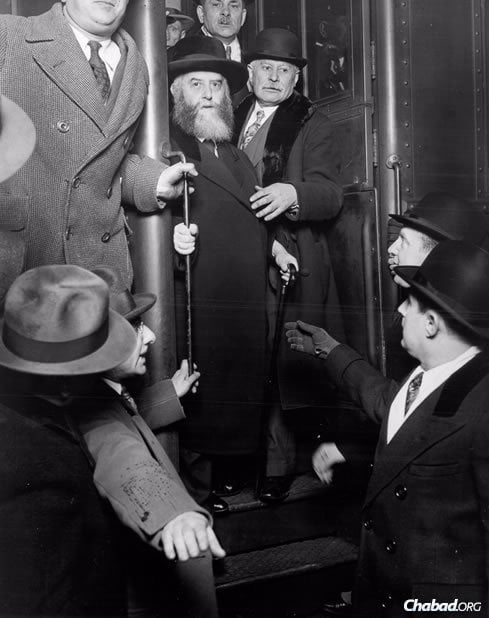
Following his release, and under mounting pressure from abroad, the Sixth Rebbe was granted permission to leave the USSR. He spent several years in Riga, Latvia, and later, in Warsaw, Poland, where he was living when the Nazis invaded in Sept. 1939. A dramatic, internationally coordinated rescue effort succeeded in saving the Rebbe from the Germans, enabling him to find refuge in the United States, where he set out to rebuild the shattered Chabad movement and rebuild international Jewry. This, too, came at a price: the Rebbe’s youngest daughter, Shaina, perished in the Nazi death camp Treblinka, together with her husband, Rabbi Mendel Horenshtein.
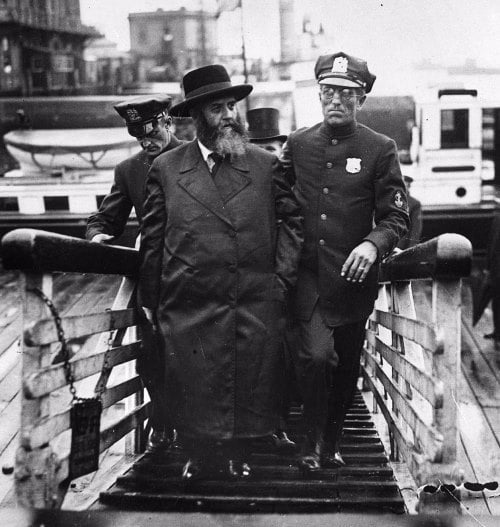
In America, he focused his energies on trying to save the Jews of Europe from the horrors engulfing them, while at the same time doing everything he could to provide spiritual succor to Soviet Jewry, a community he never forgot about. He did not neglect his new surroundings, either, and upon arriving on American shores issued his immortal rallying call: Amerika iz nisht andersh!, “America is no different!” With these words, he proclaimed that authentic, undiluted Judaism could take root and flourish on American soil just as it had in Europe. What he encountered, however, was a widespread belief that “old-fashioned” Judaism had no place in the modern New World.
Rabbi Yosef Yitzchak set into motion the beginnings of a Jewish renaissance, one that would ultimately transform the face of American Jewry and, in time, Jewish life across the globe. He reestablished the Tomchei Tmimim Yeshivah, first in New York and then in Montreal, dispatched the first Chabad shluchim (emissaries), and laid the groundwork for a vast Jewish educational network in America, Europe, the Land of Israel, North Africa and beyond. He was joined in this work by his son-in-law and eventual successor the Rebbe, Rabbi Menachem M. Schneerson, who upon arriving in New York in the summer of 1941 was placed at the helm of Merkos L’Inyonei Chinuch, the educational arm of the Chabad movement.
Building on the foundations laid by his father-in-law, whom he succeeded in 1950, the Rebbe would spearhead a global renaissance of Jewish life in the postwar era.
“The Sixth Rebbe saved Soviet Jewry through his network of underground schools and synagogues, but he also reshaped the face of Jewish life worldwide,” Eliezrie says. “The network of Jewish education and observance built in the USSR became a model for a network in the United States, and that, in turn, became the model for the vast Chabad network we see today.”
The desire for more people to know and learn from this extraordinary story is what inspired him to write the biography. Having previously authored the award-winning The Secret of Chabad and serving as Chabad’s representative to major Jewish organizations, he feels strongly that this story offers profound lessons for anyone working to shape Judaism today.
A Five-Year Labor of Love
Eliezrie did not undertake an easy task in retelling this story. Spanning two continents, seven decades, and innumerable pivotal events, the challenge of assembling the details needed for a rigorous, scholarly biography was immense. He pored over thousands of pages of documents, unearthed forgotten newspaper articles, combed through the archives of major Jewish organizations and led a team of researchers to uncover as much as possible. He also immersed himself in the historical and geopolitical context of each era, studying biographies of other Jewish figures, works on Soviet history, and additional volumes to accurately frame the Sixth Rebbe’s life and actions within their broader environment.

He traveled personally to key locations in the Sixth Rebbe’s life, including the town of Lubavitch (Lyubavichi), Rostov, Moscow and Leningrad (now St. Petersburg). In St. Petersburg, he visited the infamous Spalerno prison, still an active today, in an effort to see the very cell in which the Sixth Rebbe had been incarcerated.
It was a five-year labor of love, culminating in a biography of more than 500 pages, including 120 pages of endnotes spanning 1,645 individual references. Drawing upon the writings and diaries of the Sixth Rebbe, historical works, interviews, and the extensive material uncovered through his research, Eliezrie weaves a narrative that moves from Lubavitch to Rostov, from Riga to Warsaw, from Israel to the United States. He explores the vision that fueled the Rebbe’s courage and the far-reaching revolution he set in motion, offering a deeper look not only at what transpired, but how it came to be.
“In the [book’s] pages, we encounter his broad range of emotions, from anguish to joy, as well as boundless compassion, devotion to faith, and a desire to connect with G‑d,” Eliezrie writes in the foreword. “Above all is his sense of mission, instilled by his father, Rabbi Shalom DovBer Schneersohn. From the Rebbe’s courage facing down tyrants to his concern for the fate of Jews living in far-off Morocco, this biography helps us understand the remarkable life of one of the greatest Jewish leaders in an era of upheaval for world Jewry. His life reflects the trials of the Jewish people from the sunset of the oppressive rule of the Russian czars, to the totalitarianism of Communism, the struggle to implant a chasidic milieu in Western Europe, and the bounty of freedom offered by America. It is a story of determination, self-sacrifice, compassion, and vision.”
“Anyone who has been touched by Chabad in any way will gain insight into the driving force behind the movement,” says Eliezrie, “, “the force that stood up to Soviet oppression and continues to confront the challenges of American assimilation.
“Students of Jewish history will discover previously untold chapters of our story. And even those well-versed in Chassidic history or thought will find new layers and perspectives, especially in the book’s extensive endnotes.”

Jonathan D. Sarna, the Joseph H. & Belle R. Braun Professor of American Jewish History at Brandeis University, agrees.
“This well-researched and inspiring biography … contributes greatly not only to the history of the Chabad-Lubavitch movement, but also to the religious history of the Jewish people during the tumultuous and transformative decades that coincided with the Rebbe’s life,” he writes in his review of the book. “Undaunted draws upon Chabad documents, interviews and traditions, in addition to scholarly sources. It makes a major contribution and deserves a wide audience.”
Eliezrie is careful to note what the book is not. “It is not a treatment of the Sixth Rebbe’s corpus of Chassidic teachings.” Those teachings span 21 volumes of ma’amarim (Chassidic discourses), 11 volumes of sichot (talks) and 17 volumes of letters, many of which explore deep concepts in Chassidic thought. “To examine these properly would require at least another full work,” he explains. “Undaunted focuses on the biography, a life lesson in its own right.”
And while the book’s strong sales since its release in November show that it has quickly become a favorite, Eliezrie says that the very first sign encouraging him to undertake the project appeared even before he had begun writing.
It was a little more than five years ago, and Eliezrie had just finished morning prayers at the annual Jewish Learning Institute’s National Jewish Retreat when Chabad.org author Rabbi Mendel Kalmenson approached him.
“David, someone has got to write a book on the Sixth Rebbe,” he said. “Why don’t you do it?”
“I completely agree,” Rabbi Eliezrie replied. “In fact, I already have a book outline.”
“So what’s stopping you from continuing?” Kalmenson asked.
Rabbi Eliezrie explained that a serious undertaking like this, hiring researchers and editors, traveling internationally, and dedicating hundreds of hours to writing, required substantial funding. He named the amount needed.
At that moment, an individual sitting at the next table overheard the conversation and turned to them. “That won’t be an issue,” he said.
“It felt like a direct sign from Heaven to move forward,” says Rabbi Eliezrie.
The result is now in front of you.
To order Undaunted, click here.



Join the Discussion